Oil climbed early Monday with investors squarely focused on escalating geopolitical tensions as Israel and Iran continue to bombard each other with no sign of a pause.
Brent crude rose as much as 5.5% in early Asian trading after Israel and Iran continued attacks on one another’s territories over the weekend. Israel launched an attack on the giant South Pars gas field in the Persian Gulf, forcing the shut down of a production platform, after air strikes on Iran’s nuclear sites and military leadership last week.
Asian equity-index futures pointed to declines in Hong Kong and Sydney, while contracts for US equities edged lower. The dollar saw modest gains against major peers in early trading, while gold rose toward a record on Monday as the conflict drove investors toward haven assets.
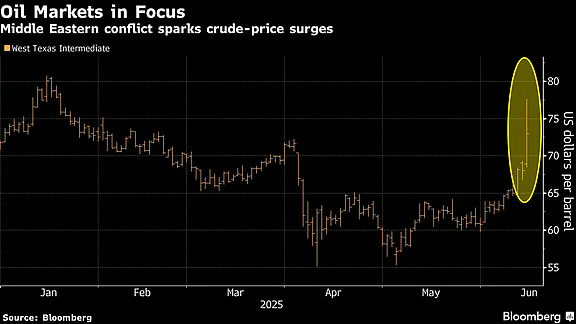
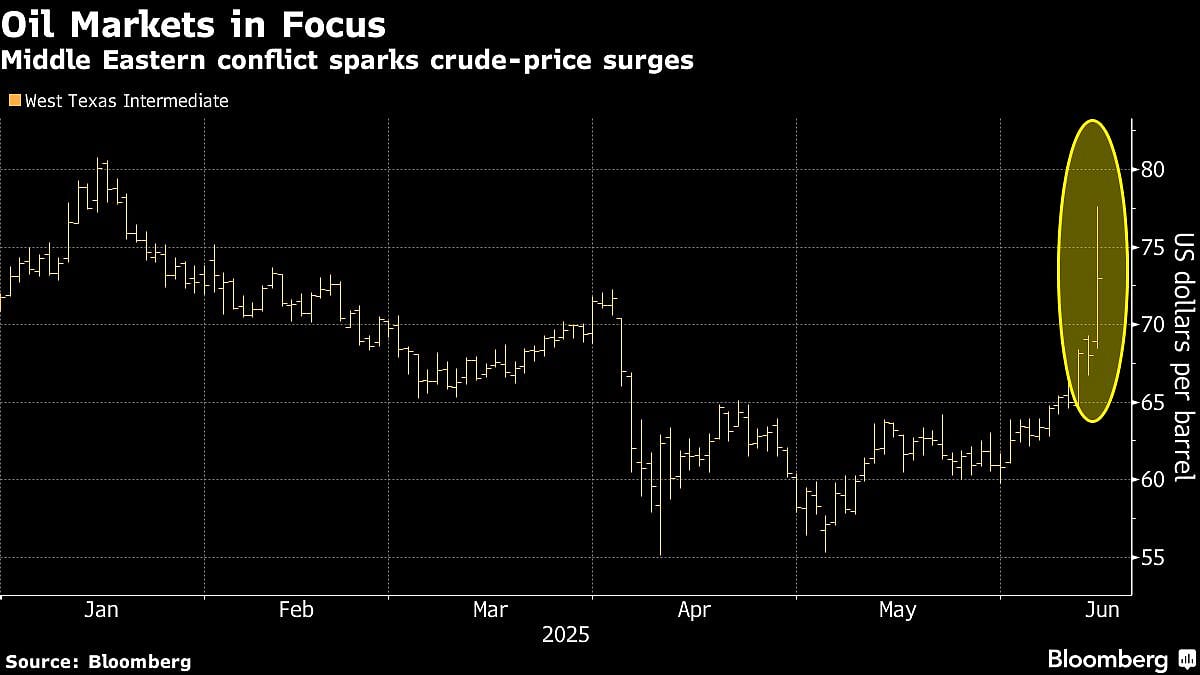
Last week’s biggest market reaction to the conflict was oil, with crude prices surging more than 13% on Friday before paring some of those gains. The biggest concern for the market centers on the Strait of Hormuz and prices could soar further if Iran attempts to block the route.
“Markets should be prepared for a prolonged period of uncertainty,” said Wolf von Rotberg, an equity strategist at Bank J. Safra Sarasin. “Hedging against potential oil supply-chain disruptions via exposure to the energy market and adding to gold, which may see an acceleration of its structural uptrend, are the best ways to protect a portfolio against a further escalation in the Middle East.”
Some investors ended last week choosing to wait to gauge how long the tensions would last, mindful of similar standoffs between the two nations that eventually de-escalated. Still, the extension of the conflict and intensity of the current hostilities is likely to cast a shadow over risk assets on Monday. Already, the MSCI World Index of developed-market equities fell the most since April on Friday following Israel’s initial air strikes on Iran.
“This is a significant escalation, to the point where these nations are at war,” said Michael O’Rourke, chief market strategist at JonesTrading. “The ramifications will be larger and last longer,” with weakness in equity markets likely, especially after recent gains, he said.
Regional Risks
Most Middle East stock indexes dropped on Sunday. Egypt’s main gauge was the worst performer, seeing the biggest losses in more than a year on concern that a halt in Israeli gas production will cause fuel shortages. In Saudi Arabia, the Tadawul gauge’s declines were limited by Aramco, which gained on higher oil prices. Israel’s benchmark ended higher as military supplier Elbit Systems Ltd. rallied.
Traders are weighing the fresh geopolitical risks at a time when they are also grappling with destabilised global trade relationships, the prospect of new tariffs from US President Donald Trump, economic cross-currents, the ongoing conflict between Russia and Ukraine and rising political tensions in the US amid protests.
“Unless oil stays elevated and drives inflation higher, this is more likely a pause than a panic as other narratives are driving the market,” said Dave Mazza, chief executive officer, Roundhill Investments. “It may present a buying opportunity, but with markets having rallied sharply off recent lows, gains from here will be harder to come by.”
Elsewhere, Taiwan blacklisted Huawei Technologies Co. and Semiconductor Manufacturing International Corp., dealing another major blow to the two companies spearheading China’s efforts to develop cutting-edge AI chip technologies. The moves are likely to at least partially cut off access to Taiwan’s plant construction technologies, materials and equipment essential to build AI semiconductors.
Some of the main moves in markets:
Stocks
-
S&P 500 futures were little changed as of 8:32 a.m. Tokyo time
-
Hang Seng futures fell 0.5%
-
S&P/ASX 200 futures fell 0.2%
Currencies
-
The Bloomberg Dollar Spot Index rose 0.1%
-
The euro fell 0.1% to $1.1536
-
The Japanese yen fell 0.3% to 144.55 per dollar
-
The offshore yuan was little changed at 7.1882 per dollar
-
The Australian dollar was little changed at $0.6486
Cryptocurrencies
-
Bitcoin rose 0.7% to $105,500.33
-
Ether rose 1.7% to $2,547.33
Bonds
-
Australia’s 10-year yield advanced eight basis points to 4.23%
Commodities
-
West Texas Intermediate crude rose 1.7% to $74.23 a barrel
-
Spot gold rose 0.4% to $3,446.03 an ounce
. Read more on Markets by NDTV Profit.Brent crude rose as much as 5.5% in early Asian trading after Israel and Iran continued attacks on one another’s territories over the weekend. Read MoreMarkets, Business, Bloomberg
NDTV Profit