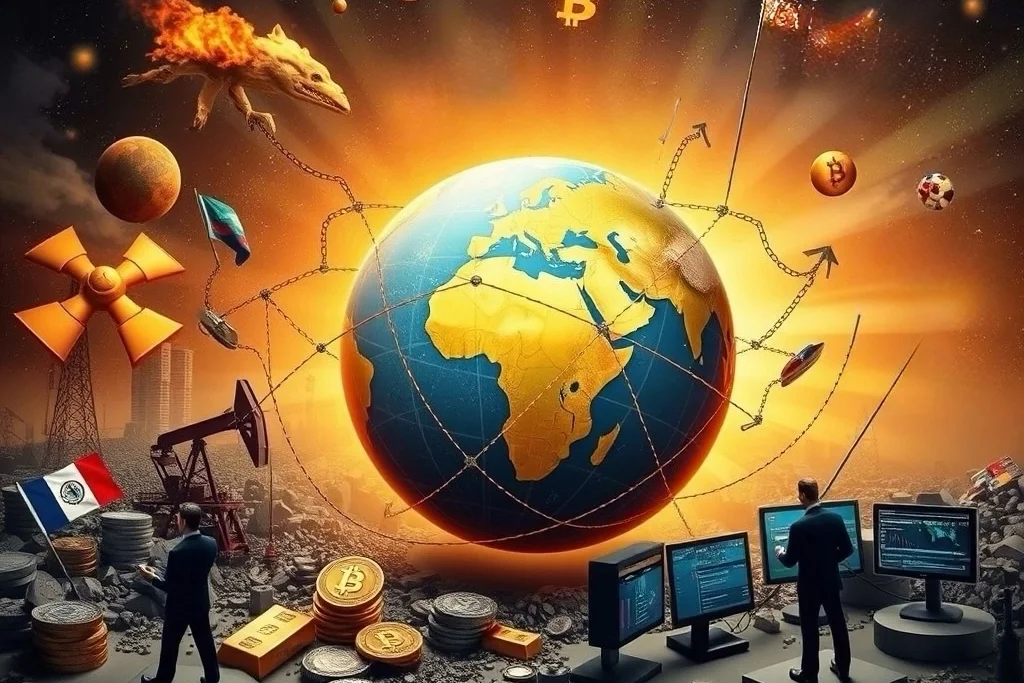
The year 2025 has ushered in a wave of geopolitical uncertainty, with two major conflicts reshaping how investors approach the markets. Tensions in Yemen and between India and Pakistan have upended the old playbook, pushing investors to look beyond the simple labels of “risky” or “safe” assets. Instead, every flare-up is now weighed for its potential to ripple through global systems-disrupting trade, energy flows, and financial stability. These shifts mark a turning point for us: Geopolitics is no longer a distant concern, but rather a central force that drives investment decisions in an interconnected world where volatility reigns.
Energy Markets on Edge: The Middle East and Beyond
The Middle East remains a hotspot of instability, with no clear resolution in sight in the near future. Despite U.S. diplomatic efforts, tensions involving Iran, Israel, Lebanon, and Syria could intensify over the next few years, with escalation risks peaking between 2026 and 2028. The stakes are high for energy markets. A disruption in the Strait of Hormuz-a critical chokepoint for oil and liquefied natural gas (LNG)-could push …
Full story available on Benzinga.com
The year 2025 has ushered in a wave of geopolitical uncertainty, with two major conflicts reshaping how investors approach the markets. Tensions in Yemen and between India and Pakistan have upended the old playbook, pushing investors to look beyond the simple labels of “risky” or “safe” assets. Instead, every flare-up is now weighed for its potential to ripple through global systems-disrupting trade, energy flows, and financial stability. These shifts mark a turning point for us: Geopolitics is no longer a distant concern, but rather a central force that drives investment decisions in an interconnected world where volatility reigns.
Energy Markets on Edge: The Middle East and Beyond
The Middle East remains a hotspot of instability, with no clear resolution in sight in the near future. Despite U.S. diplomatic efforts, tensions involving Iran, Israel, Lebanon, and Syria could intensify over the next few years, with escalation risks peaking between 2026 and 2028. The stakes are high for energy markets. A disruption in the Strait of Hormuz-a critical chokepoint for oil and liquefied natural gas (LNG)-could push …
Full story available on Benzinga.com
The year 2025 has ushered in a wave of geopolitical uncertainty, with two major conflicts reshaping how investors approach the markets. Tensions in Yemen and between India and Pakistan have upended the old playbook, pushing investors to look beyond the simple labels of “risky” or “safe” assets. Instead, every flare-up is now weighed for its potential to ripple through global systems-disrupting trade, energy flows, and financial stability. These shifts mark a turning point for us: Geopolitics is no longer a distant concern, but rather a central force that drives investment decisions in an interconnected world where volatility reigns.
Energy Markets on Edge: The Middle East and Beyond
The Middle East remains a hotspot of instability, with no clear resolution in sight in the near future. Despite U.S. diplomatic efforts, tensions involving Iran, Israel, Lebanon, and Syria could intensify over the next few years, with escalation risks peaking between 2026 and 2028. The stakes are high for energy markets. A disruption in the Strait of Hormuz-a critical chokepoint for oil and liquefied natural gas (LNG)-could push …Full story available on Benzinga.com Read Morecontributors, Equities, Expert Ideas, Commodities, Opinion, Economics, Markets, Trading Ideas, Equities, Commodities, Opinion, Economics, Markets, Trading Ideas, Benzinga Markets