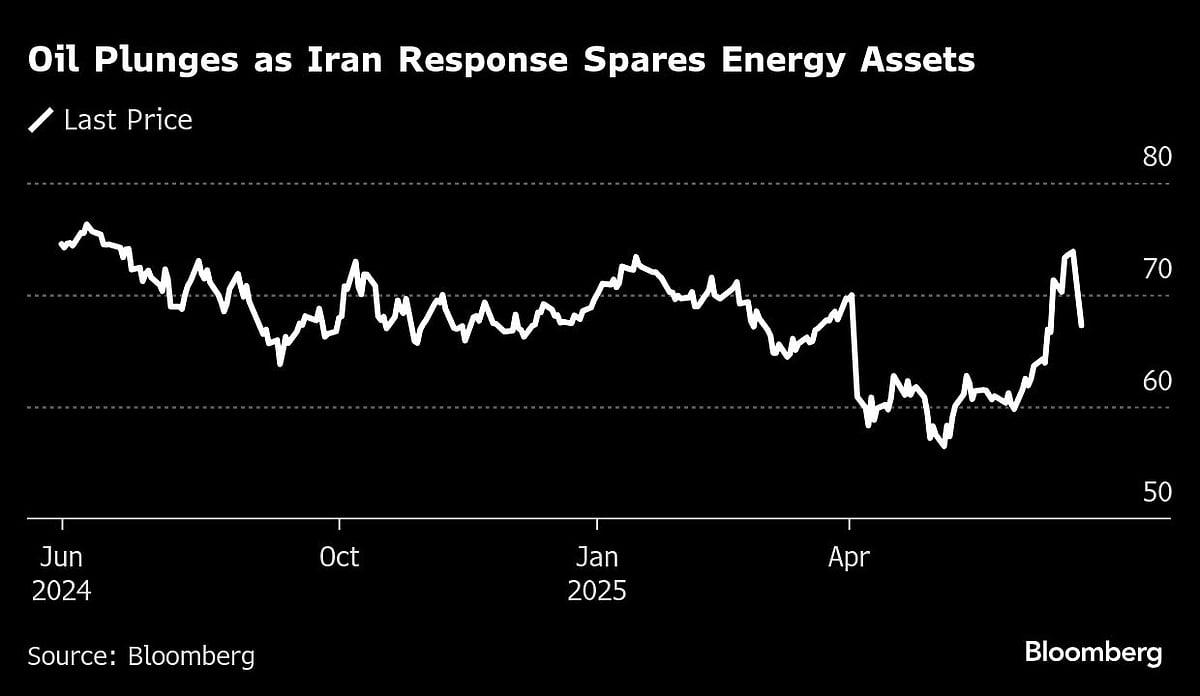
Oil slumped and US stock-index futures rallied after President Donald Trump announced a tentative ceasefire between Israel and Iran, spurring optimism the worst of the Middle East conflict is over.
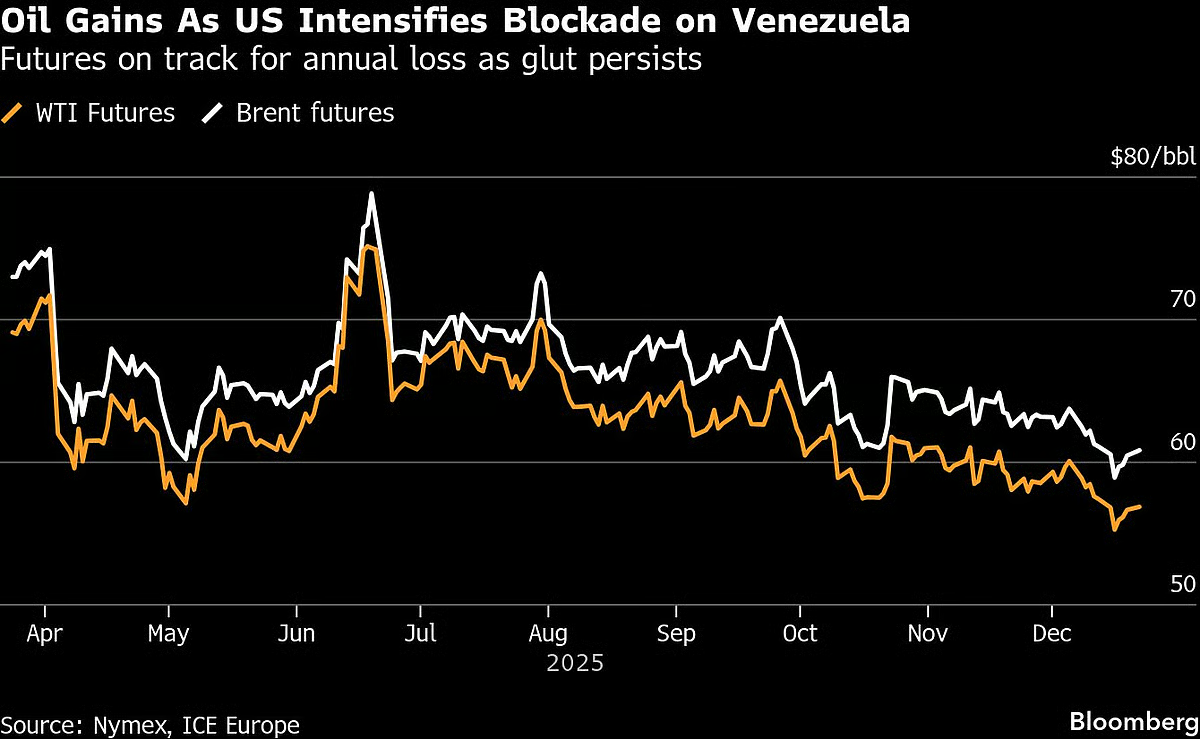
West Texas Intermediate crude tumbled as much as 6% in early Asian trading after Trump made the surprise comment on his Truth Social platform. The statement followed Iran’s strikes on a US base in Qatar, which were seen as largely symbolic, pushing the S&P 500’s gain to 1% on Monday and sending oil below $70.
S&P 500 futures rose 0.5% Tuesday, while stocks opened higher in Japan and Australia. The dollar weakened against all its Group-of-10 peers and Treasury futures fell.
“The prospect of a prolonged conflict with US involvement has been repriced, giving the green light to add risk,” said Chris Weston, head of research at Pepperstone Group Ltd. in Melbourne. “As Trump himself has signaled, it’s time for markets to refocus on the key themes: economics, inflation, tariffs, and the passing of the “One Big, Beautiful Bill.”
Trump, who made the truce announcement days after ordering airstrikes on Iran’s nuclear facilities, said the accord had been agreed upon by both countries. There was no immediate comment from Iran or Israel. The US leader had earlier raised hopes of de-escalating the Middle East conflict, saying the Iranian attack was “very weak” and telegraphed by Tehran.
Iran fired missiles at a US air base in Qatar earlier Monday after promising it would respond “proportionately and decisively” to the weekend bombing by American forces of three nuclear facilities. Qatar said the missile barrage was intercepted and the base had been evacuated in advance.
China’s Controls
In Asia, geopolitical concerns remained dominant. China moved to tighten control over two chemicals that can be used to make fentanyl, in an apparent olive branch to the US that may help maintain their fragile trade truce. Still, Beijing criticised the strike on Iranian nuclear facilities and reiterated it’s willing to join international efforts to restore peace in the Middle East.
The Middle East accounts for about a third of global crude production and there haven’t yet been any signs of disruption to physical oil flows, including for cargoes going through the Strait of Hormuz. Since Israel’s attacks began earlier this month, there have been signs Iranian oil shipments out of the Gulf have risen rather than declined.
The Bloomberg Dollar Spot Index dropped 0.2%, following a similar decline in Monday. The Australian and New Zealand dollars both strengthened about 0.3%.
“The US dollar was one of the key beneficiaries of the hostilities so it is now rolling over,” said Sean Callow, a senior analyst at InTouch Capital Markets in Sydney. “Investors have been very keen to draw a line under the Israel-Iran conflict, choosing to leave aside any concerns over the path Iran might choose beyond the very short term.”
While the conflict in the Middle East is dominating headlines, selloffs caused by geopolitical events tend to be brief, according to Morgan Stanley strategists.
“History suggests most geopolitically-led selloffs are short-lived/modest,” strategists led by Michael Wilson wrote in a note on Monday. “Oil prices will determine whether volatility persists.”
According to the Morgan Stanley team, prior geopolitical risk events have led to some volatility for equities in the short term, but one, three and 12 months after the events, the S&P 500 has been up 2%, 3%, and 9%, on average, respectively.
Meantime, bond investors watching the latest geopolitical developments are on alert for hints on when the Federal Reserve will deliver the two 2025 interest-rate cuts officials projected at their latest policy meeting.
Fed Chair Jerome Powell will have two chances this week to explain to lawmakers why he and most of his fellow policymakers seem resolved to continue holding interest rates steady at least until September, ignoring Trump’s persistent calls to lower borrowing costs.
He will testify before the House Financial Services Committee on Tuesday, and again on Wednesday before the Senate Banking Committee.
Stocks
-
S&P 500 futures rose 0.5% as of 9:01 a.m. Tokyo time
-
Hang Seng futures rose 0.3%
-
Japan’s Topix rose 1%
-
Australia’s S&P/ASX 200 rose 0.7%
-
Euro Stoxx 50 futures were little changed
Currencies
-
The Bloomberg Dollar Spot Index fell 0.2%
-
The euro rose 0.2% to $1.1600
-
The Japanese yen rose 0.2% to 145.84 per dollar
-
The offshore yuan was little changed at 7.1753 per dollar
Cryptocurrencies
-
Bitcoin rose 1.5% to $105,395.48
-
Ether rose 2.7% to $2,412.78
Bonds
-
The yield on 10-year Treasuries was unchanged at 4.35%
-
Japan’s 10-year yield advanced one basis point to 1.415%
-
Australia’s 10-year yield declined two basis points to 4.19%
Commodities
-
West Texas Intermediate crude fell 4.4% to $65.51 a barrel
-
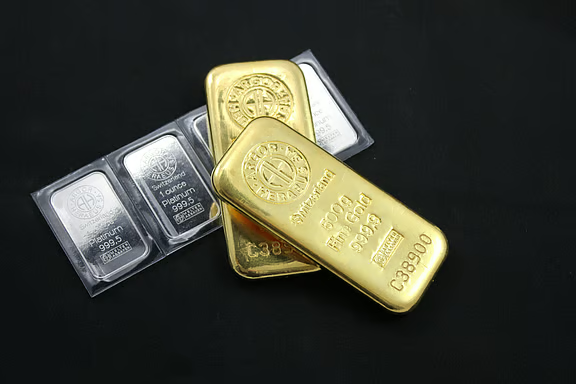
Spot gold fell 0.9% to $3,338.93 an ounce
. Read more on Markets by NDTV Profit.West Texas Intermediate crude tumbled as much as 6% in early Asian trade Read MoreMarkets, Business, Bloomberg, Notifications
NDTV Profit